
Federal Release Scope for Polk
The Federal Bureau of Prisons operates federal prisons and contracted facilities across the country. Research found no BOP prison in Polk County, Tennessee. A person with a Polk connection may serve a federal sentence elsewhere after arrest, court proceedings, and designation to a BOP institution. The BOP Inmate Locator is therefore a system page, not a local facility roster.
Federal custody can begin before BOP appears. The U.S. Marshals Service manages federal prisoners during court proceedings and transportation, often using local or contract facilities. A Polk County booking marked released to USMS describes a handoff between custodians. It is not proof that the person returned to the community. Some federal pretrial detainees may never have a BOP locator result because their custody remained with USMS while the case was pending.
| Federal channel | What it can establish |
|---|---|
| BOP Inmate Locator | Sentenced BOP identity, current location, or past BOP release |
| Federal court docket | Release order, dismissal, judgment, sentence, or supervision action |
| Polk jail record | Local movement time and the agency that received custody |
| USMS | Custody role, but no general public prisoner locator |
Search Federal Polk Releases
Use the official BOP Inmate Locator when federal sentenced custody is plausible. An agency identifier is the strongest search key. The locator accepts a BOP Register number as well as DCDC, FBI, or INS numbers. A name search can be narrowed with age, race, and sex filters. Compare all returned identifiers before treating a result as the same person from Polk County.
- Choose the number search when a federal identifier is known.
- Otherwise enter the exact first, middle, and last name and available demographic filters.
- Match the register number and identity fields.
- Read the facility or status text and the displayed release date together.
- Use the federal case docket for the legal order and any later supervised-release action.
The official BOP locator displays the federal search fields and results route.
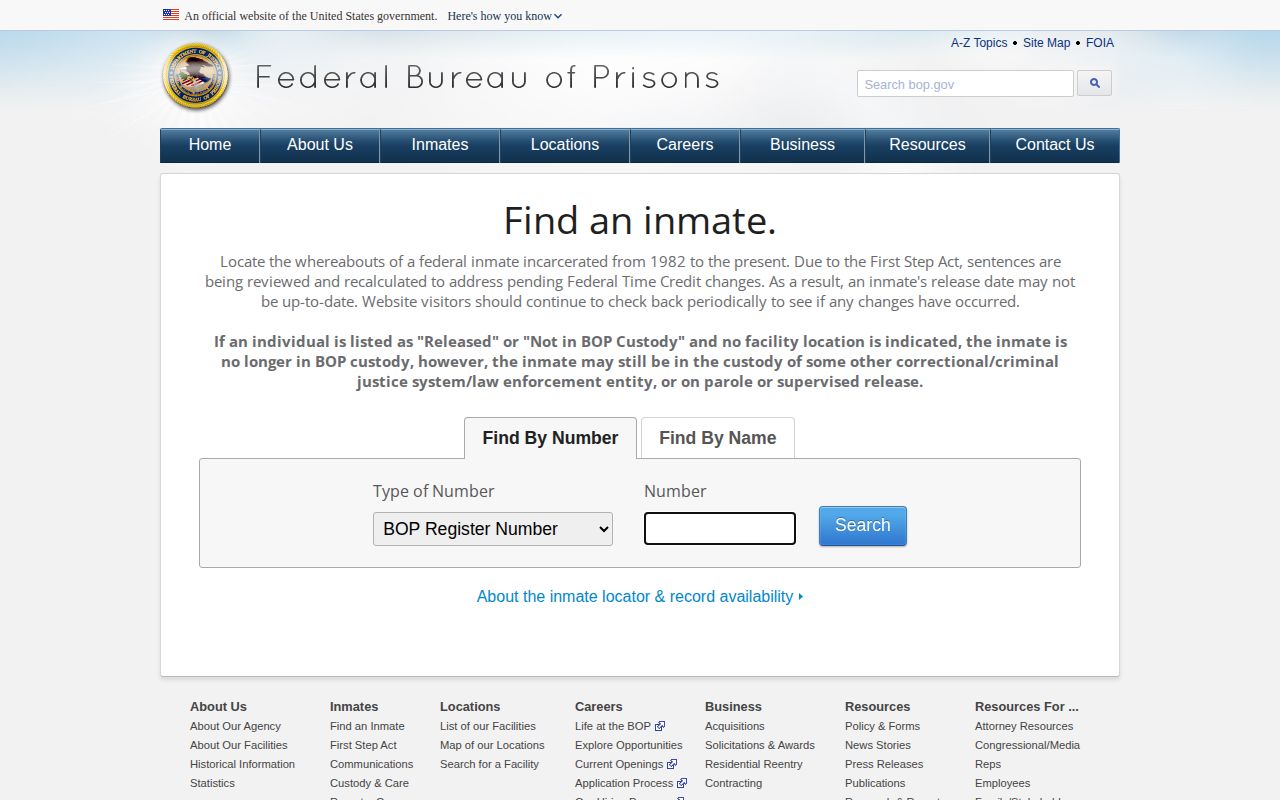
Its result must be read as a BOP record, not as proof of release from Polk County, TDOC, USMS, or ICE custody.
BOP generally provides records from 1982 to the present. Historical data can have limits, and projected dates may change with sentence computation or later legal events. Preserve the exact result label and search date. A name-only match is not enough, especially when a common name returns several people.
Read BOP Release Results
A historical BOP result may show “Released” and a release date, or may show no current institution. The date answers when BOP custody ended for that federal record. It does not supply a Polk County door-out time, establish the result of an unrelated state case, or show that federal supervised release has ended. Supervised release is a court-ordered period in the community after prison and is tracked through the sentencing court and federal probation system.
Other locator text requires care. A community-corrections location can mean a residential reentry center or another form of BOP placement rather than final release. “In Transit” indicates movement within custody. “Unknown” should not be rewritten as released. A projected date can change, including after sentence recalculation. Use the literal text and avoid turning a forecast into a completed event.
- Register number
- The BOP identifier used to distinguish one federal record.
- Release date
- The date shown for departure from the BOP sentence record.
- Supervised release
- Court-ordered community supervision after federal confinement.
- Designation
- BOP assignment of a sentenced person to an institution.
Note: A BOP result does not document an ordinary Polk County jail release unless the person actually entered the federal prison system.
Polk Transfer to USMS
Start with PCSO when the last known custody was the Polk County Detention Center. Ask for the booking and release event, exact movement timestamp, disposition, and destination. If the destination says USMS, federal custody continued even though Polk closed its local booking. The receiving authority and federal docket become the next sources.
USMS oversees federal detainees during proceedings and movement, but it offers no public nationwide prisoner locator comparable to BOP's. The federal district court record can show an order of detention or release, dismissal, plea, judgment, sentencing, or later modification. PACER or the sentencing district clerk is the durable legal source. A federal court order authorizing release and the actual physical movement can occur at different times when processing or another hold remains.
If a person is later sentenced and designated, BOP may add the record after transfer. A short delay does not prove release. When no BOP result appears, verify the identifier, consult the federal case, and determine whether the person remains in pretrial USMS custody. ICE custody requires its own locator and ERO route, not the BOP search.
The Polk County release and transfer search covers the local event fields that should be collected before moving to the federal system. Those details prevent a local custody handoff from being reported as community release.
Federal Release Record Sources
BOP's locator is the fastest public check, but it is not the complete federal case or institutional file. For a legal outcome, request the relevant docket entry or certified order from the federal court. For sentence computation, use BOP's official channels tied to the prison record. State the exact record sought, the register number, date range, and why the displayed date needs clarification.
A full federal release timeline can require several records. The Polk jail record shows a local transfer. The federal docket explains detention, sentence, or release authority. The BOP locator gives current institution or a historical release date. A later federal court entry may address supervised release, revocation, or termination. None should be made to answer a question owned by a different source.
- Keep the BOP register number with every locator capture.
- Record whether the displayed date is projected or historical.
- Preserve the name of the sentencing court and case number.
- Check for another custody system only when the event record supports it.
- Use the original office when a status or date conflicts.
Federal systems are dynamic. Save the access date and exact displayed text. A later lookup may differ after a correction, transfer, or new custody event.
Federal System Contact Route
The BOP Inmate Locator is the primary public contact route for a former federal prisoner. The BOP page explaining locator information and data limits provides context for historical and changing records. The sentencing district's clerk supplies the court-order path. If the person was last at Polk County Detention Center, PCSO remains the source for the county release or transfer event.
Federal Bureau of PrisonsNationwide federal prison system
Public route: BOP Inmate Locator
Coverage: federal sentenced custody, generally 1982 to present
No physical federal prison address is listed here because the research did not identify a federal facility inside Polk County. A matched BOP result supplies the assigned institution when the person is still in custody. Contact that institution only after identity is matched and the locator shows it as the responsible facility.
For possible federal pretrial custody, use the federal case and clerk rather than searching random local jail directories. For immigration detention, use ICE ODLS and ERO. Each channel has a defined scope. The clean conclusion should say exactly which custody ended, on what displayed date, and what official record supports the statement.
Verify Federal Community Release
A past BOP release date establishes the end of the displayed BOP confinement event. It does not establish that all federal court duties ended. Review the sentencing docket for supervised release, later modification, revocation, or termination. If the person moved to another custodian on the same date, record that transfer instead of calling it unrestricted community release.
The source order matters. Begin with the last known custodian, preserve the movement entry, and follow the named receiving agency. Use BOP only for BOP custody. Use the federal court for legal authority and USMS-related pretrial movement. Use ICE for immigration detention. When sources conflict, compare identifiers and event dates, then ask the office that owns the disputed field.
Older federal records can contain data gaps, especially outside the locator's general 1982-forward range. Do not fill a blank with an estimate. A certified court order, institutional response, or other official record can answer what a public locator cannot. State the limit plainly until that evidence is obtained.
Note: “Not in BOP custody” narrows one system only; it does not exclude county, state, USMS, ICE, or later federal custody.
Polk Federal Release Timeline
Build the timeline with event-specific proof. The Polk booking sheet gives the local exit time and recipient. The federal docket shows the detention or release authority. BOP adds institution, status, and a historical or projected date for a federal sentence. A supervised-release order explains obligations after prison. When a later custody system appears, add it as a new event rather than changing the meaning of the BOP entry.
This method also exposes gaps. If USMS accepted custody but BOP has no result, the person may still have been pretrial, in transport, or never designated to a federal prison. The next step is the federal case, not an unsupported release claim.
Keep the register number, case number, source date, and exact status wording together. Those details make a later update or agency inquiry easier to reconcile with the original Polk movement.